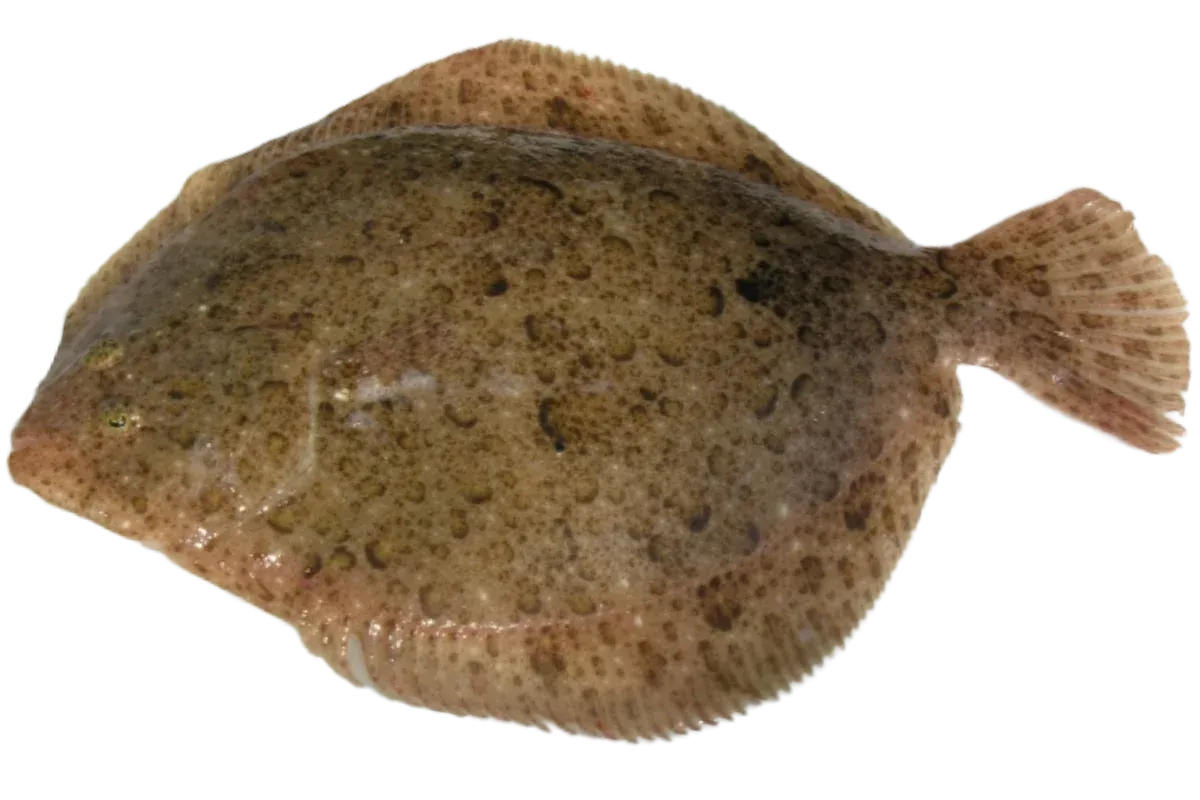
Brill
Scophthalmus rhombus
The Brill, which is also frequently referred to as the Barbue, is a large flatfish belonging to the Scophthalmidae family. It is the closest relative of the Turbot and closely resembles it in both appearance and meat quality. Like the Turbot, the Brill is a left-eyed flatfish, meaning both eyes are on the left side of its body. This side faces upward when the fish is lying on the seabed.
However, significant differences exist to distinguish it from the Turbot. The body of the Brill is more oval rather than nearly circular. The skin is smooth and covered with regular soft scales without the hard bony tubercles found on its relative. Additionally, the first rays of its dorsal fin near the mouth are free and branched to form a small characteristic fringe or lace. The colour ranges from light brown to beige, with small spots resembling freckles that offer perfect camouflage in the sand.
Habitat
It lives exclusively on the bottom and prefers sandy and muddy seabeds where it can bury itself slightly. The fish is usually encountered at depths from 5 to 50 metres. It is a euryhaline species, which means it can tolerate changes in salinity and consequently often enters river estuaries and brackish waters to feed.
Diet
The animal is a very fast and voracious ambush predator. It remains hidden in the sand and attacks passing prey instantly. It feeds mainly on other benthic fish, such as gobies and sand eels, as well as small hake, and on larger crustaceans and molluscs.
Reproduction
Reproduction of the Brill in the Mediterranean takes place in the spring and summer, usually from March until August. During this period, the fish move to shallower waters to spawn. The eggs are pelagic and float in the water.
Fisheries
It represents an important commercial catch, although it is caught in smaller quantities than the Turbot. It is caught mainly with set nets and bottom trawls and sometimes with longlines. Its commercial value is high, but it is usually sold slightly cheaper than the Turbot. The meat is of exceptional quality, white, with a sweet, fine flavour, and easy to fillet. Many prefer it because it is easier to clean than the Turbot due to its lack of bony tubercles and its slightly softer texture.
Research
The International Union for Conservation of Nature classifies the Brill as a species of Least Concern globally. However, studies have shown that in some regions, such as the Black Sea and Turkish waters, populations are declining, and it is considered Near Threatened due to overfishing and habitat degradation. Research into its development showed that wild fish grow faster than the first generation of farmed fish and that diet plays a decisive role in their reproductive capacity.