Brown Comber
Serranus hepatus
Size: It is a very small fish. The usual length ranges from 5 to 10 centimetres. The maximum length it can reach is 15 centimetres, although such sizes are rare, making it much smaller than the comber and the painted comber, which reach 25 to 30 centimetres.
NE
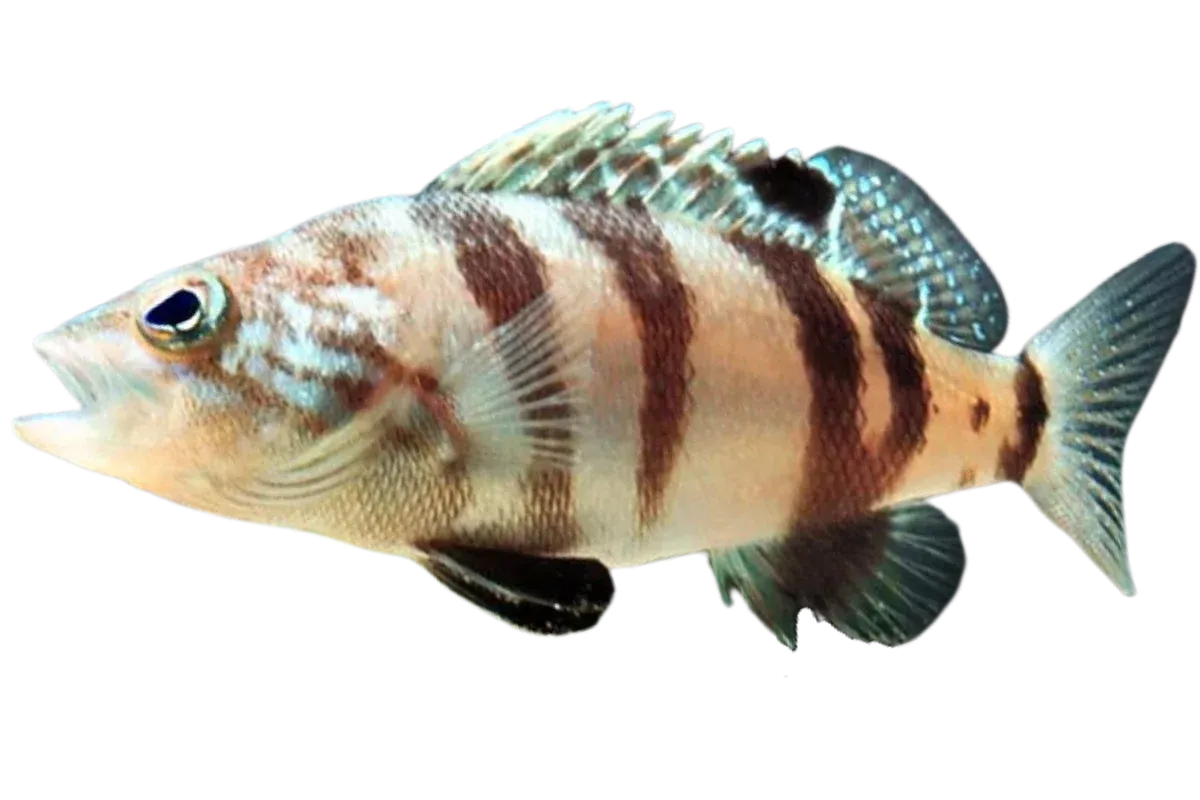
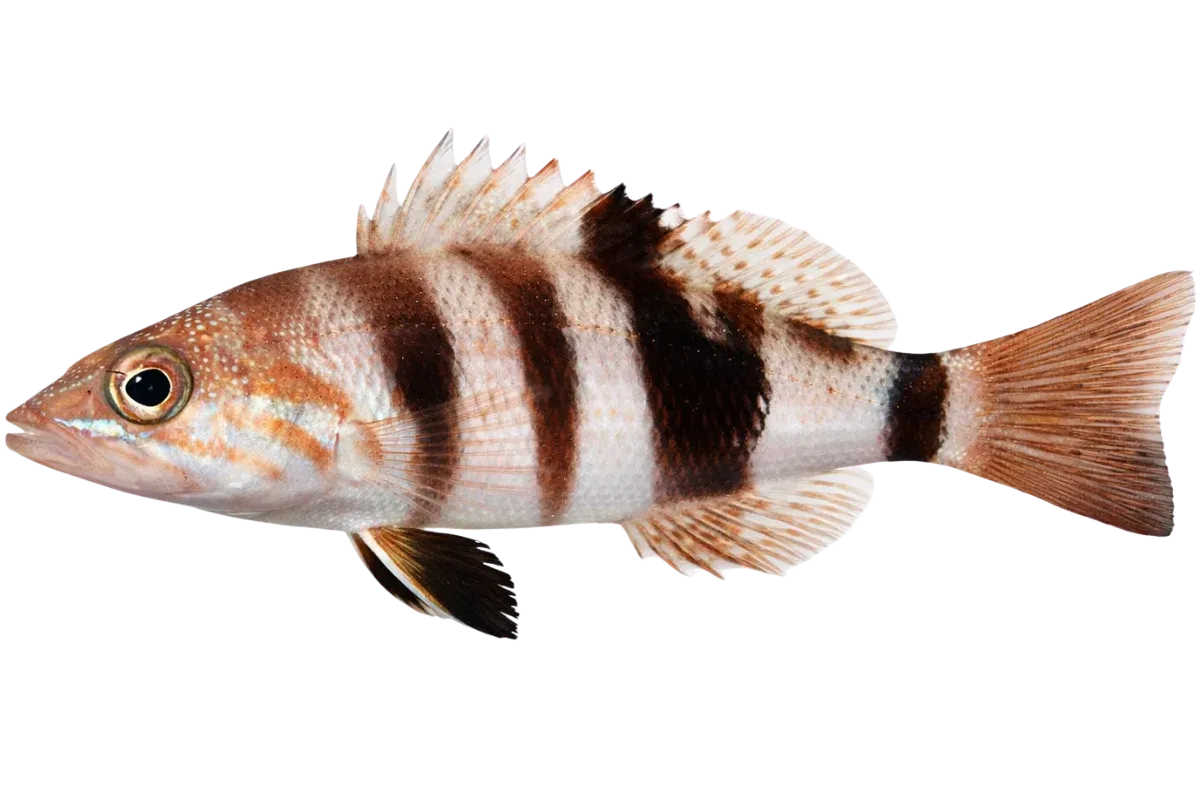
The Brown Comber, which is also commonly referred to as the Dwarf Bass, is the smallest member of the Serranidae family in the Mediterranean, meaning it represents the little brother of the comber, the painted comber, and the dusky grouper. It is a small and pleasant fish that often goes unnoticed due to its size and cryptic lifestyle. The body is short and robust, slightly high in the back, with the head quite large in proportion to the rest of the body. The colour is usually reddish-brown or yellowish, with three to five wide, dark vertical stripes running down its sides.
The most characteristic feature that distinguishes it immediately from its relative, the Comber, involves the presence of an intense, round, black spot in the centre of the soft part of the dorsal fin. This spot is a hallmark of the species. Additionally, its pelvic fins and the lower part of the anal fin are often pitch black.
Habitat
This is a benthic species that lives near the bottom. It prefers sandy and muddy seabeds as well as Posidonia seagrass meadows, where it can hide among the vegetation. It is encountered at depths ranging from 5 metres to 100 metres. It represents a solitary fish and does not stray far from its specific territory.
Diet
Despite its small size, the animal is a voracious carnivorous predator of the bottom. It feeds mainly on small benthic crustaceans such as shrimp, small crabs, and mysids that it finds in the sediment or among the seaweed. It also consumes polychaete worms and small molluscs.
Reproduction
The Brown Comber is a simultaneous hermaphrodite species, like the painted comber. This means that each individual possesses active testes and ovaries simultaneously and can function as both male and female. Reproduction takes place during the warm months from spring until summer, between March and August. The eggs and larvae are pelagic and drift with the currents.
Fisheries
It has almost no commercial value due to its very small size. It is primarily caught as unwanted bycatch by bottom trawlers and handlines targeting other species. It is usually discarded at sea, or, if it is of a suitable size, used in fish soups along with other small fish to flavour the broth.
Research
The International Union for Conservation of Nature classifies the Brown Comber as a species of Least Concern. Scientific studies have shown that its diet varies with season and depth: in spring, it feeds more on mysids, tiny shrimp, while in summer it turns to decapods like crabs. Furthermore, research has observed that it represents a species that adapts well to life in an aquarium.
Local names around the Mediterranean
Italy
Sacchetto
Spain
Merillo
France
Serran hépate
Turkey
Benekli hani
Malta
Burkax iswed
North Africa (Tunisia/Libya/Egypt)
Serran or Samak al Chanoui
Adriatic Coast (Croatia/Slovenia)
Vučić
Greece
Chanoui