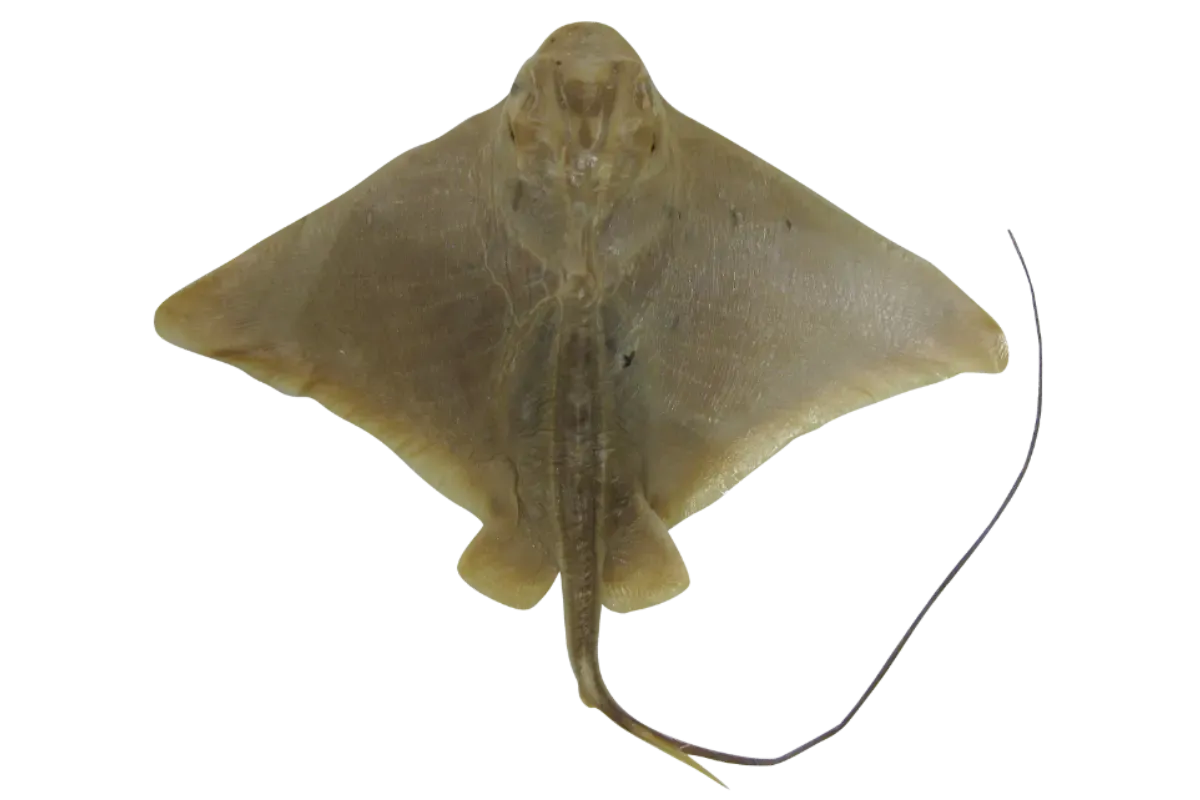
Eagle Ray
Myliobatis aquila
The Common Eagle Ray is an impressive fish related to sharks. Its name is derived from its large triangular pectoral fins that resemble eagle wings when it swims. The body has a characteristic diamond shape and is significantly wider than it is long. It features a rounded snout and eyes located on the sides of the head, which provide a wide field of vision. The dorsal colouration ranges from dark brown to olive or greyish, while the belly is white. Its skin is smooth and lacks the hard thorns found on many other ray species. It moves elegantly by flapping its fins up and down, appearing as if it is flying through the water.
⚠️ Safety warning
The Common Eagle Ray possesses one or more venomous spines at the base of its tail, which it uses exclusively for defence if it feels threatened. The venom is heat-labile, meaning it breaks down at high temperatures. If stung, you should immediately submerge the affected area in very hot water at approximately 45°C to 50°C for 30 to 90 minutes to relieve the pain. Thoroughly clean the wound to prevent infection and seek medical attention if necessary.
First aid
The venom in the tail spine is destroyed by heat. If you are stung, you must immediately submerge the area in very hot water at about 45°C to 50°C for 30 to 90 minutes to relieve the pain. You should clean the wound thoroughly to avoid infection and seek medical help if needed.
Habitat
It primarily lives near the coast in areas with sandy or muddy bottoms. It can be found at depths ranging from just a few metres down to 300 metres. It frequently uses its snout or fins to dig into the sand to locate prey.
Diet
A specialised bottom hunter, it feeds almost exclusively on molluscs such as mussels, oysters, and clams, as well as crabs and shrimp. It has very strong teeth arranged in rows that form a hard plate, ideal for crushing the tough shells of its prey. Research in the Adriatic Sea has shown that molluscs constitute over 50 per cent of its diet.
Reproduction
Its reproduction is of particular interest because it is an ovoviviparous species in which eggs hatch within the mother, and the young are born live. Pregnancy lasts between 6 and 8 months. It usually gives birth in late summer or early autumn in shallow waters, bringing 3 to 7 young into the world, miniature replicas of their parents.
Fisheries
The Common Eagle Ray is not a primary target for professional fishermen because its meat is not considered particularly tasty and is often discarded. However, it is very frequently caught as bycatch in trawl nets and longlines. Recreational anglers may occasionally catch it with handlines. Due to its slow reproductive rate and high mortality from accidental fishing, the populations have declined significantly.
Research
The International Union for Conservation of Nature has classified the Common Eagle Ray as Critically Endangered in the Mediterranean. Its populations have suffered a massive decline in recent decades due to overfishing, despite it not being a primary commercial species. Scientific studies indicate that females are larger and heavier than males and live longer for up to 16 years, while males live approximately 10 years. Additionally, they form large schools, a behaviour that makes them even more vulnerable to industrial trawling.