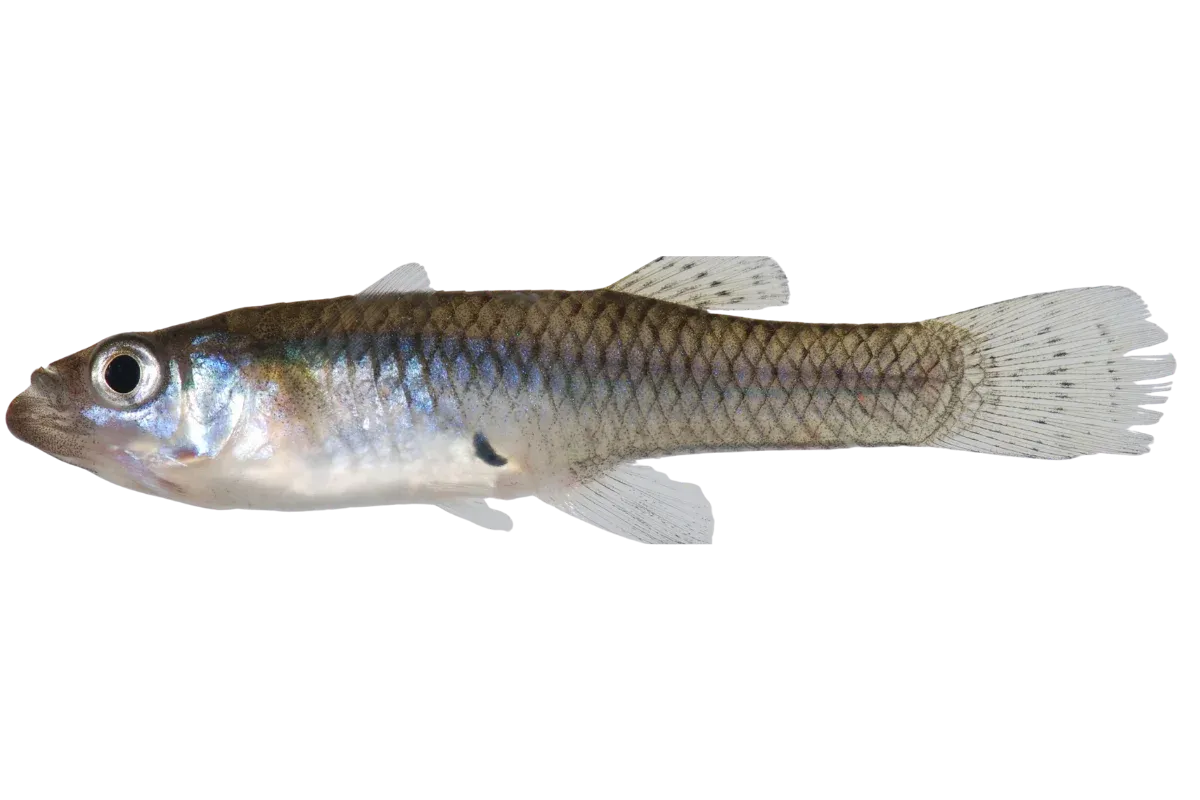
Eastern Mosquitofish
Gambusia holbrooki
The Eastern Mosquitofish is a small fish of fresh and brackish water that originates from North America, specifically the eastern United States. It was introduced to Europe and the Mediterranean at the beginning of the twentieth century for a very specific purpose: controlling mosquitoes and malaria. The body is small and robust with an olive or grey-green colour and a silvery shine on the belly. It has an upward-facing mouth, which is a clear indication that it feeds at the water surface. The most characteristic feature is the pronounced sexual dimorphism, with females much larger and more robust than males.
Habitat
It is one of the most adaptable and resilient fish species on the planet. It lives primarily in shallow stagnant or slow-moving fresh waters such as lakes, marshes, canals, and rivers. However, it has the amazing ability to survive in the brackish waters of lagoons and estuaries while enduring high temperatures and low oxygen levels that would be fatal to most other fish. This adaptability allows it to dominate environments where native species struggle to survive.
Diet
The Eastern Mosquitofish is an omnivorous and exceptionally voracious feeder. It feeds primarily on mosquito larvae and pupae at the water surface, which is why it is known internationally as the Mosquitofish. However, it is not limited to insects. It also consumes zooplankton, small crustaceans, algae, and plant remains. A major ecological problem is that it also consumes the eggs and young of other fish and amphibians, including rare native species.
Reproduction
Its reproduction is viviparous. Unlike most fish that lay eggs, the female carries the young inside her body and gives birth to live and fully formed offspring. This provides the young with a massive survival advantage. It reproduces several times a year rapidly during the warm months, and a population can increase exponentially within just a few weeks.
Fisheries
Ecological Threat & Impact on Native Species
Although it was introduced as a beneficial species, the fish is now considered one of the 100 worst invasive species in the world by the International Union for Conservation of Nature. In the Mediterranean, it poses a deadly threat to the native South European Toothcarp. The Eastern Mosquitofish is extremely aggressive and bites the fins of native fish and eats their eggs, displacing them from their habitats. Research has shown that the native toothcarp now survives primarily in areas with very high salinity, such as salt pans, where the invasive species finds it difficult to live.
Research
Scientific studies have questioned the effectiveness of the fish in controlling mosquito populations because it often prefers other food sources when they are available, while ignoring mosquito g larvae altogether. Furthermore, research has shown that its presence reduces aquatic ecosystem biodiversity by eliminating rare invertebrates and amphibians. Its resilience to pollution and extreme environmental conditions makes it almost impossible to remove from an area once a population has become established.