Mediterranean Moray
Muraena helena
Size: The Mediterranean Moray can reach a fairly large size. Its usual length ranges from 60 to 100 centimetres, but it can exceed 1.3 metres and weigh 6 to 8 kilograms, even though reports of larger individuals up to 1.5 metres exist.
NE
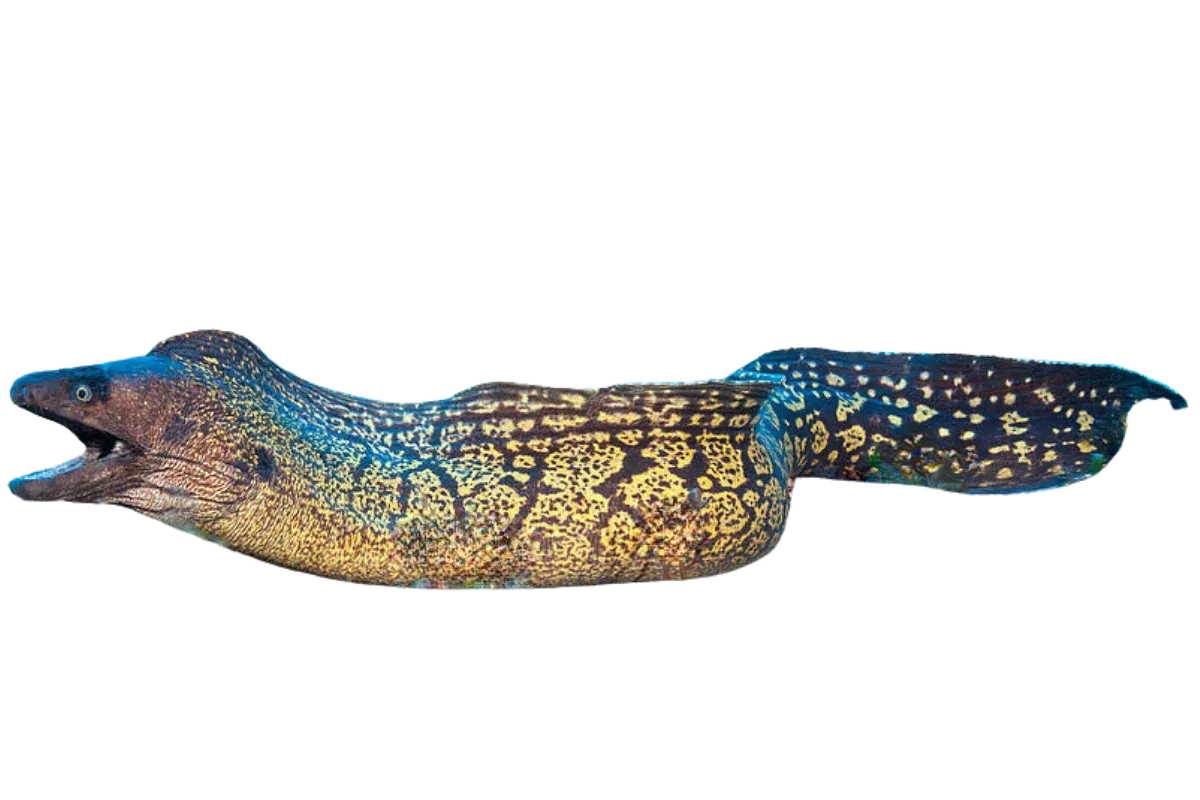
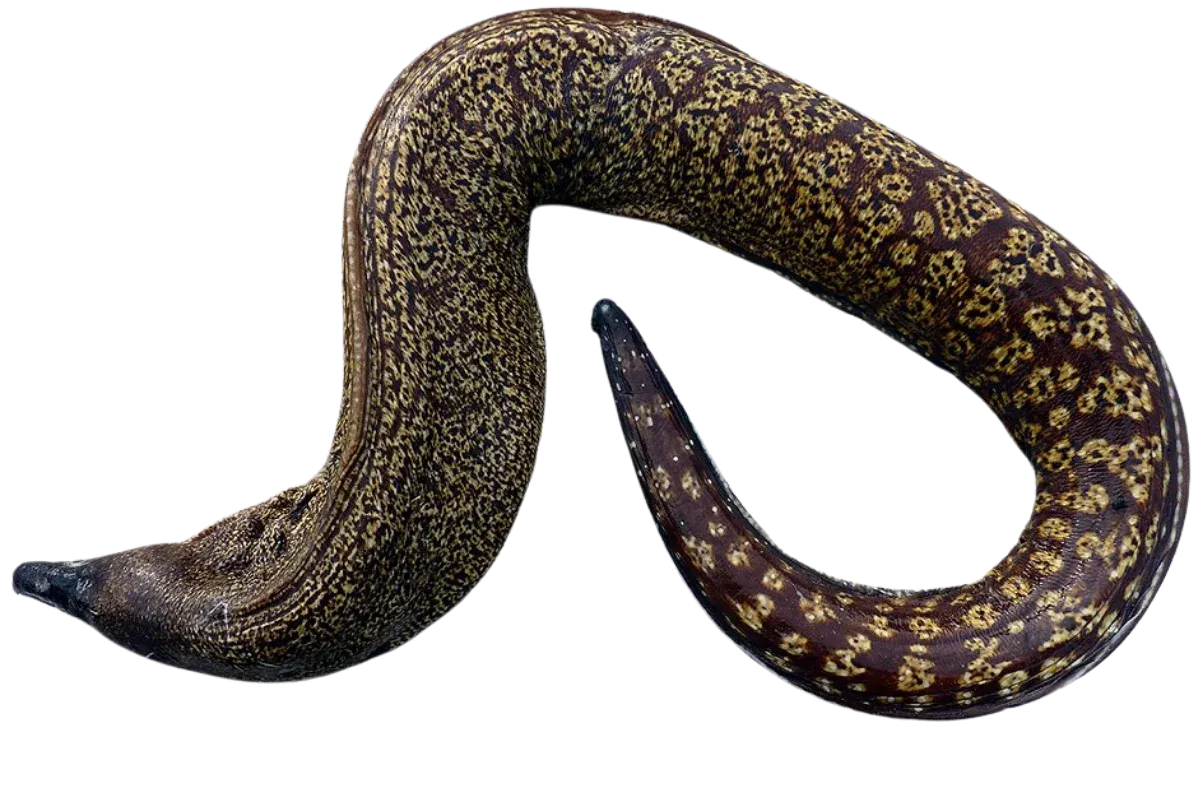
The Mediterranean Moray, also known in some areas as the Moray Eel or simply the Moray, is one of the most recognisable and misunderstood fish in regional waters. It has a long, snake-like body without scales or paired fins, including pectoral or pelvic fins. The dorsal fin starts exactly behind the head and merges with the tail. The skin is thick, smooth, and covered with protective mucus. Its colour is striking while featuring dark brown or black with irregular yellow or white spots in a marbled pattern that provides perfect camouflage among the rocks.
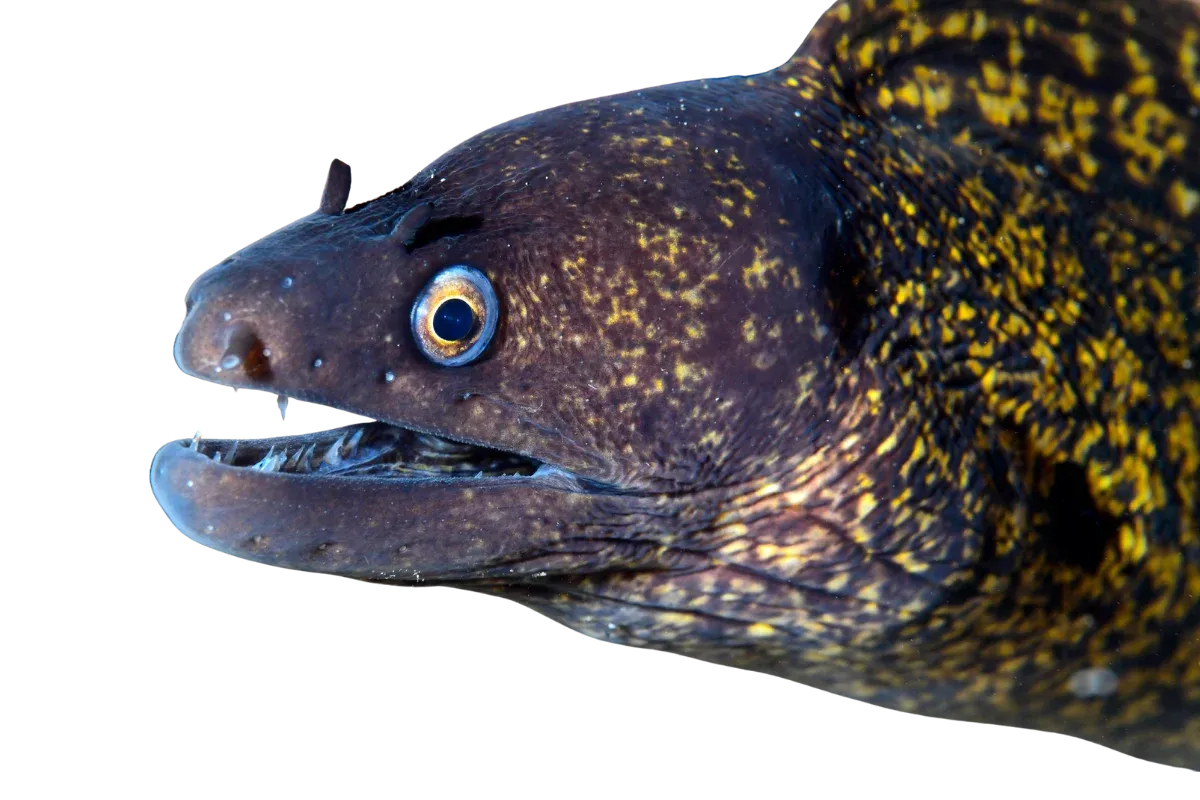
The most characteristic feature consists of its head. Although relatively small, it possesses a huge mouth that reaches behind the eyes. The jaws are armed with long, pointed, and very sharp teeth that tilt inward, making the escape of prey impossible.
The Secret Weapon: Pharyngeal Jaws
Scientific research has revealed that the Mediterranean Moray possesses a unique feeding mechanism similar to that of the creature in the movie Alien. In addition to the normal jaws, it has a second set of jaws in its throat known as pharyngeal jaws. When it catches prey with its mouth, the pharyngeal jaws lunge forward to grab the victim and pull it deep into the oesophagus.
Habitat
It is a benthic species that lives in rocky areas, reefs, and shipwrecks. It prefers shallow and medium depths, usually from the surface down to 100 metres. It is a strictly territorial fish. It spends the day hidden in narrow holes and rock crevices, leaving only its head visible.
Diet
The animal is a nocturnal and ruthless predator. It leaves its shelter at night and hunts mainly using its highly developed sense of smell, as its vision is relatively poor. Its diet includes fish and cephalopods such as octopuses and cuttlefish, which are among its favourite delicacies, along with crustaceans. It often cooperates with other fish, such as the Dusky Grouper, to trap its prey. A symbiotic relationship has also been observed with cleaner shrimp, which enter its mouth to clean its teeth of parasites without being eaten.
Reproduction
Reproduction occurs during the warm months, usually from February to July, depending on water temperature. It is a gonochoristic species with separate sexes, and its eggs are pelagic.
Fisheries
It is caught with set nets, longlines, traps, and handlines. For underwater fishers, it is an easy target but requires caution, as it reacts violently and can attack if not struck decisively. Although the meat is white, fatty, and extremely delicious, it has low commercial value. This is due to its fearsome appearance, numerous bones, and difficult preparation, which requires skinning because of its tough skin. It is ideal for soup, grilled, or fried.
Research
The International Union for Conservation of Nature classifies the Mediterranean Moray as a species of Least Concern due to its wide distribution and population stability. Scientific studies have focused on the complex mechanism of its pharyngeal jaws, which allow it to swallow large prey in narrow spaces where it cannot use suction like other fish.
Local names around the Mediterranean
Italy
Murena
Spain
Morena
France
Murène
Turkey
Müren
Malta
Morina
North Africa (Tunisia/Libya/Egypt)
Murène or Samak al smera
Adriatic Coast (Croatia/Slovenia)
Mrina
Greece
Smerna or Smyrna