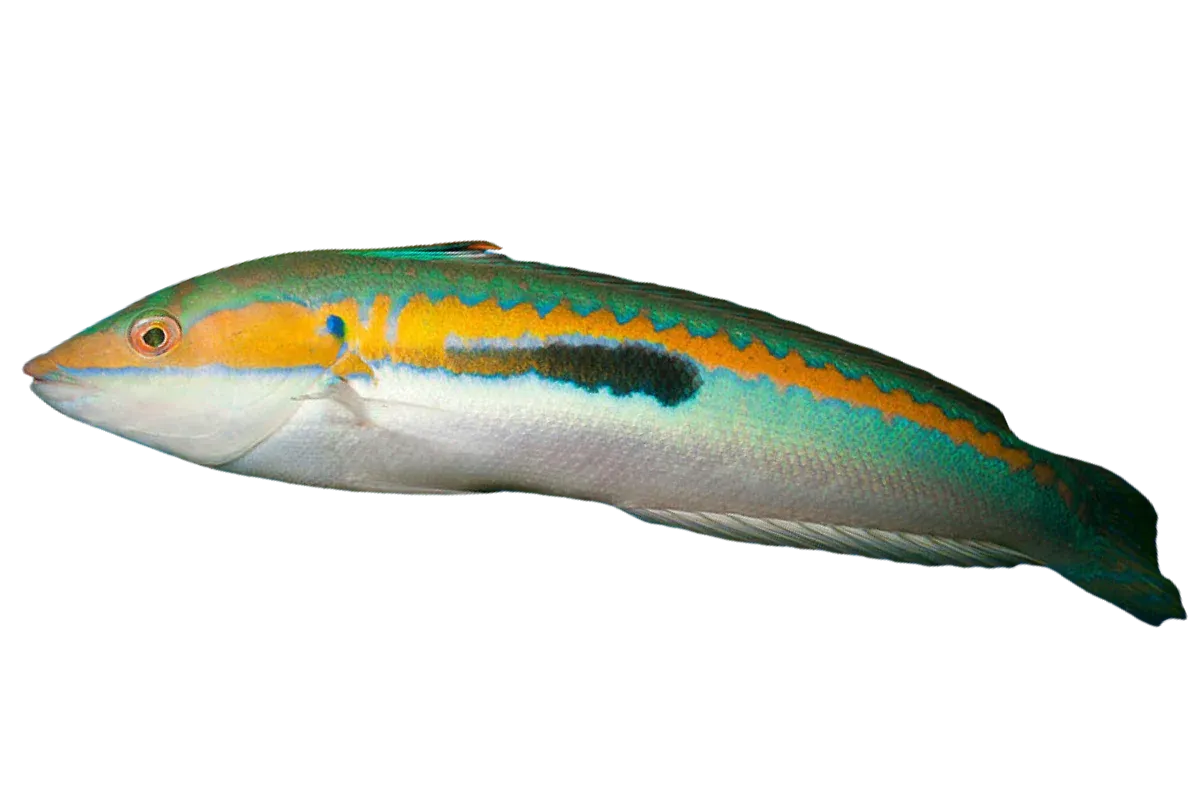
Mediterranean Rainbow Wrasse
Coris julis
The Mediterranean Rainbow Wrasse is one of the most colourful and common fish in the region and belongs to the family Labridae. It is famous for its impressive sexual dimorphism, as males and females have such different appearances that they were once considered separate species. Females and juveniles in the initial phase feature a brown-orange back and a white belly with a distinct white horizontal line. Dominant males in the terminal phase display dazzling colours, including bright green, blue, and red, with a characteristic orange zig-zag line along their sides. The body is elongated and agile, which makes it ideal for manoeuvring among rocks.
Habitat
This coastal species lives in shallow waters, usually at depths between 1 and 60 metres, although it can be found down to 120 metres. It prefers rocky seabeds with rich vegetation and Posidonia seagrass meadows where it finds abundant food and shelter. It exhibits a unique behaviour: it buries its entire body in the sand to sleep when night falls or when it feels threatened, protecting itself from predators.
Diet
It is a carnivorous fish that is active during the day. It feeds primarily on small gastropods, snails, and sea urchins, along with small shrimp, worms, and other invertebrates found on the seabed. Young individuals often act as cleaners by removing parasites from the skin of larger fish.
Reproduction
The species is a protogynous hermaphrodite. All individuals are born as females. When they reach a certain size of about 18 centimetres and age, or when the dominant male of the area is lost, the largest females change sex and transform into males while simultaneously acquiring their impressive colours. Breeding takes place during the warm months from May to August.
Fisheries
It is easily caught with handlines, traps, and nets, but it has very little commercial value. Although the meat is flavourful, it has many small bones, making it difficult to eat. It is commonly used for making tasty traditional fish soup or as live bait for catching large predators such as the common dentex and amberjack.
Research
The International Union for Conservation of Nature classifies the species as Least Concern because it is very common and populations remain stable. Scientific studies have focused on its sleeping behaviour and confirmed that it follows a strict circadian rhythm. It is active only during daylight hours and buries itself in the sand as soon as the sun sets, where it remains dormant until dawn. Furthermore, research has shown that the sex change process is flexible and heavily influenced by the social structure of the group where the fish lives.