Salema Porgy
Sarpa salpa
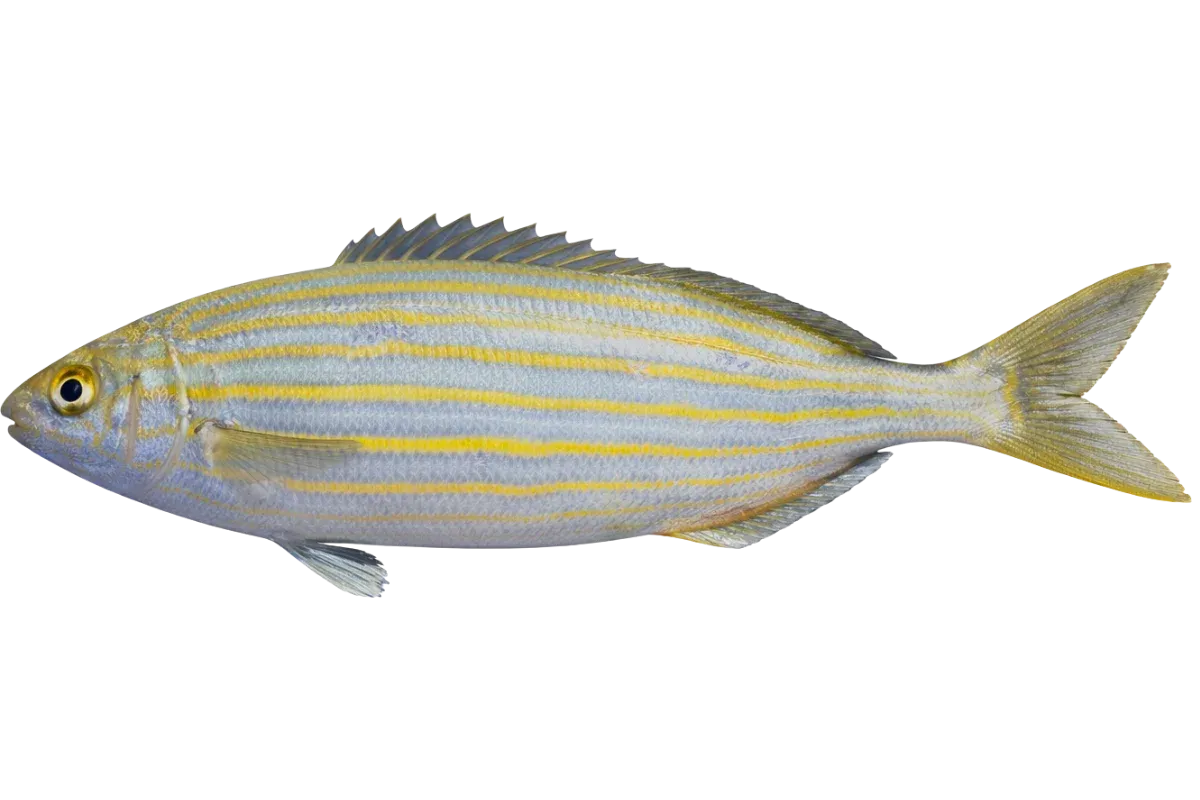
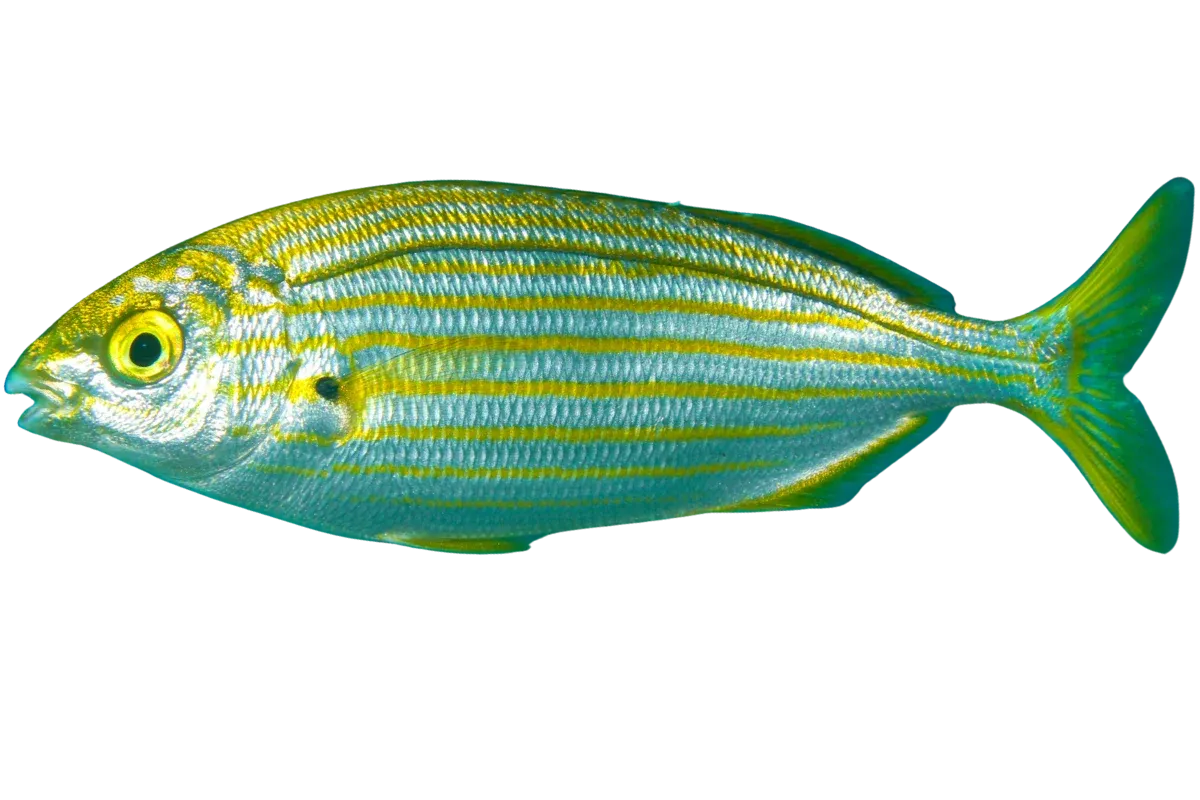
The Salema Porgy, which is also commonly referred to as the Salema, the Dreamfish, the Goldline, or the Cow Bream, is one of the most common and easily recognisable fish of coastal waters belonging to the Sparidae family. The body is oval and elongated with a silver colour that often has greenish or blue reflections on the back. Its most striking and distinctive feature is the 10 to 12 bold, golden horizontal stripes that run along its sides from the head to the tail, making it stand out immediately in the water.
Its eyes are relatively small and golden in colour. The mouth is small but possesses very sharp teeth that resemble incisors, which it uses to shave algae off the rocks.
⚠️ Safety warning
The consumption of the Salema Porgy and especially its head can, in rare cases, cause a form of poisoning called ichthyoallyeinotoxism. This is caused by toxins that accumulate in fish when they feed on specific algae, such as Caulerpa. The symptoms include vivid visual and auditory hallucinations, along with nightmares and dizziness that can last for days. For this reason, the Romans referred to it as the dream maker fish.
Habitat
It is a coastal benthic species that lives in shallow waters, usually from the surface down to 20 metres deep, although it can reach 70 metres. It is an extremely social fish and forms dense, populous schools that move with absolute synchronisation, like a single organism. It is found mainly on rocky bottoms and Posidonia seagrass meadows, where it finds abundant food.
Diet
This section describes the great peculiarity of this species. It is the only fish of the Sparidae family in the Mediterranean that is strictly herbivorous as an adult. While young individuals feed on small crustaceans, adults feed exclusively on algae and marine vegetation, grazing continuously on the rocks like cows of the sea.
Reproduction
The species is a protandrous hermaphrodite. It is born male and later in life changes sex, becoming female. Reproduction takes place in two periods, once in the spring, during April and May, and once in the autumn, between September and November.
Fisheries
It is easily caught from the shore using nets, traps, and rods, with dough or seaweed as bait. Its commercial value is low mainly due to its diet. Because it eats vegetation, its intestines smell very strong and unpleasant. If it is not cleaned immediately after being taken from the sea, by removing the viscera and the black abdominal membrane, the meat becomes bitter and smells bad. However, when properly cleaned and fresh, it is considered very tasty, especially when grilled over charcoal.
Research
The International Union for Conservation of Nature classifies the Salema Porgy as a species of Least Concern. Scientific studies have highlighted its critical ecological role in controlling algal growth on rocky reefs. Furthermore, research has linked its toxicity to consumption of the invasive seaweed Caulerpa taxifolia, which contains the toxin caulerpin, and has confirmed that the risk of hallucinations increases when the fish feeds in areas with high concentrations of this plant.