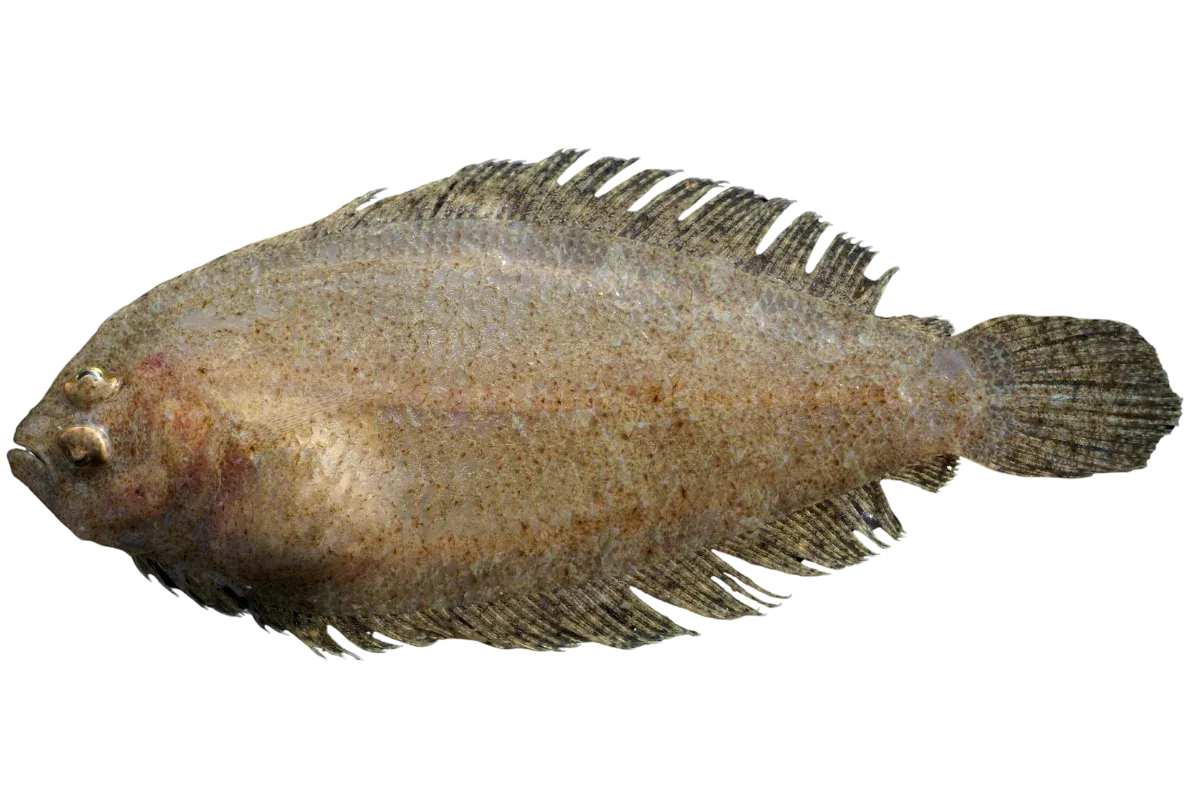
Scaldback
Arnoglossus laterna
The Scaldback is a small flatfish commonly found in Mediterranean waters. Its English name refers to its extremely delicate scales, which fall off at the slightest touch and give the fish a scalded or bare appearance. Like all flatfish, it begins life as a symmetrical fish, but as it matures, the right eye migrates to the left side of the head. Consequently, it lies on its right side on the seabed with both eyes situated on the left or upper side. Its colouration is mottled grey-brown with dark spots that provide perfect camouflage against the substrate, while the underside is white.
Habitat
The Scaldback is a strictly bottom-dwelling fish, usually found partially buried in sand or mud, waiting for prey. It inhabits a wide range of depths, from shallow waters of 10 metres to 200 metres, though it prefers depths around 50 metres.
Diet
An ambush predator, the Scaldback feeds primarily on small fish such as gobies and various invertebrates. This includes small shrimp, crabs, and worms that live within the sandy substrate.
Reproduction
In the Mediterranean, spawning occurs mainly in spring and summer, peaking from May to August. The eggs and larvae are pelagic until the juveniles undergo metamorphosis and settle on the seabed, reaching a length of approximately 2 to 3 centimetres.
Fisheries
Due to its small size and extreme fragility, the Scaldback is not a targeted species for fisheries. However, it is very frequently caught as bycatch by bottom trawlers. Because of its low commercial value, it is often discarded at sea, although its meat is quite flavourful and can be consumed fried.
Research
Studies in the Aegean Sea have shown that the Scaldback reaches sexual maturity very early at a length of just 7 to 8 centimetres and can live for up to 8 years. Dietary research indicates that juveniles feed mainly on microscopic crustaceans, whereas larger individuals transition to a diet consisting of small fish and larger crabs. Despite intensive trawling pressure, the population appears resilient and is currently classified as Least Concern by the IUCN.