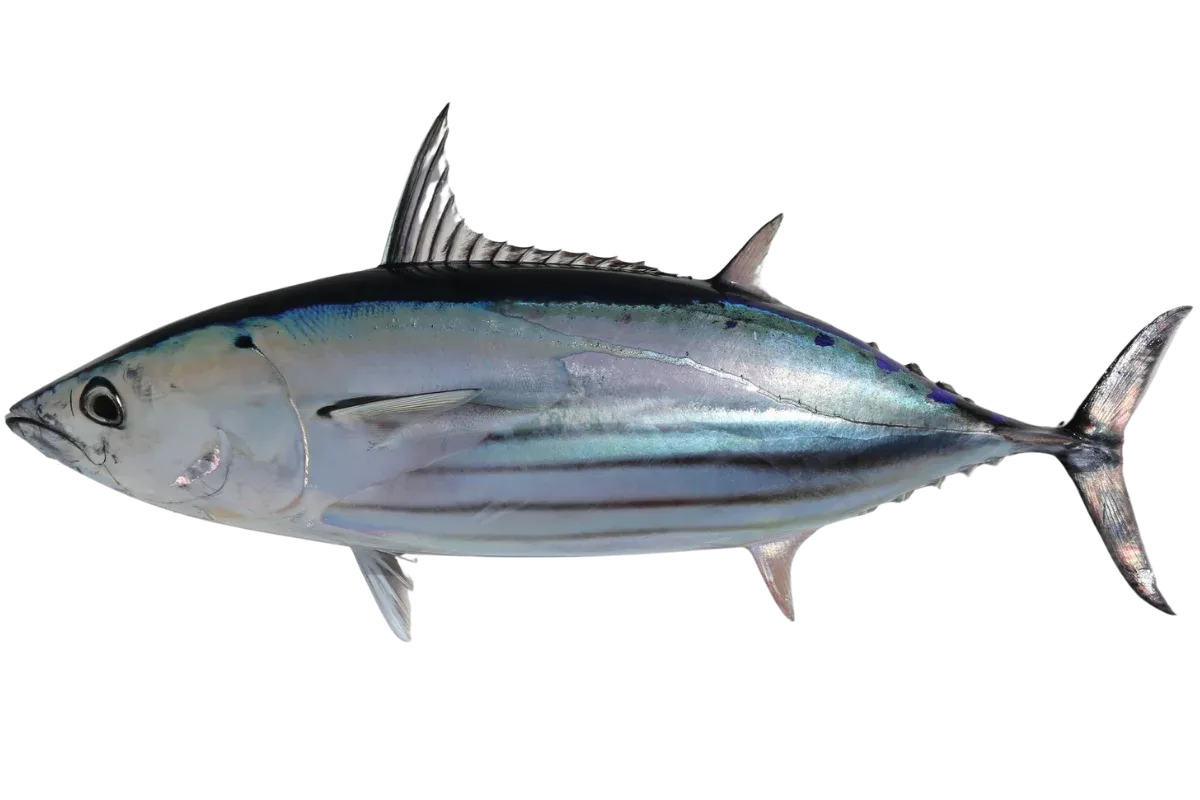
Skipjack Tuna
Katsuwonus pelamis
The Skipjack Tuna is one of the most significant commercial fish globally and belongs to the Scombridae family. It is the species that provides the raw material for the majority of canned tuna on the market. The body is robust and spindle-shaped, with no scales except for the chest area and the lateral line. The back colour is dark blue-purple, while the sides and belly are silver.
Its most characteristic feature, which distinguishes it from its relatives, is its stripes. The fish has 4 to 6 bold dark horizontal stripes exclusively on its belly and lower sides. This is the opposite of the Atlantic Bonito, which has oblique stripes on its back, and the Little Tunny, which has spots on its belly and patterns on its back.
Habitat
This is a cosmopolitan epipelagic species that lives in tropical and temperate waters worldwide, including the Mediterranean. It prefers warm waters with temperatures above 15 degrees Celsius and lives in the open sea far from the coast. It forms massive schools that often number tens of thousands of individuals, and it tends to swim near the surface, often following floating objects and whales.
Diet
The animal is a voracious and opportunistic predator that feeds mainly at dawn and dusk. Its diet includes fish such as sardines and anchovies, along with crustaceans like shrimp and cephalopods. Cannibalism is a common phenomenon as larger individuals often eat smaller ones of the same species.
Reproduction
The reproduction of this tuna is extremely efficient. The species reaches sexual maturity very quickly, usually at 1.5 years, when it reaches 40 to 45 centimetres. In warm tropical waters, it reproduces year-round, but in the Mediterranean, breeding is limited to the warm months from spring through early autumn. The females are exceptionally fertile and release their eggs in multiple batches.
Fisheries
The species has enormous commercial value and is among the main catches worldwide. It is caught industrially using purse seines and pole-and-line techniques. The meat is darker and has a stronger flavour than that of the Yellowfin or the Albacore, but it is very popular canned, smoked, or dried, such as the Japanese katsuobushi.
Research
The International Union for Conservation of Nature classifies the fish as a species of Least Concern. Scientific studies emphasise that it is one of the most resilient tuna species against fishing pressure. This is due to its very rapid growth rate, fast sexual maturation, and short lifespan of 8 to 12 years, which allows populations to renew quickly. Furthermore, research has shown that it tends to accumulate less mercury compared to larger tuna because of its smaller size and shorter life.