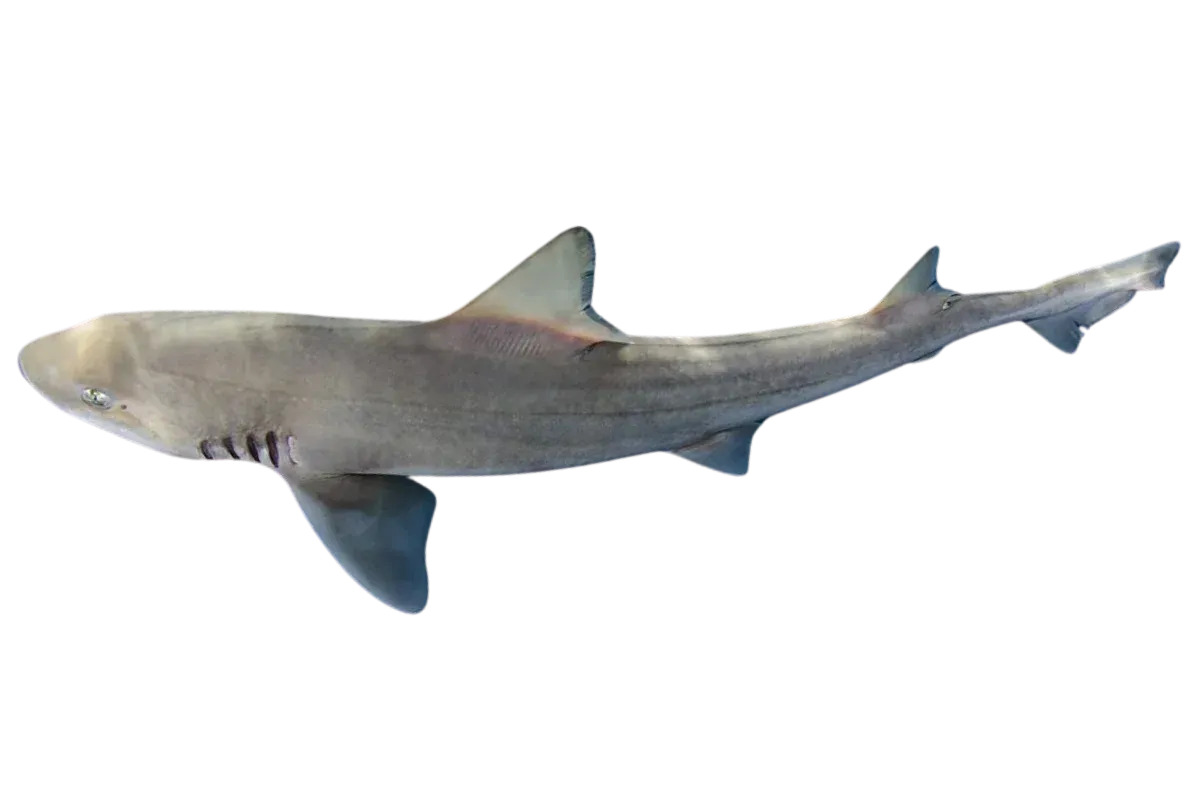
Smooth hound
Mustelus mustelus
The Smooth hound is a medium-sized shark belonging to the family Triakidae, and it is often mislabeled as Tope in local markets. Unlike most sharks, which have sharp triangular teeth, this species has flattened teeth that resemble small plates, designed to crush hard shells. The body is elongated, and the snout is short and rounded rather than pointed. The dorsal colour is uniform grey or grey-brown without spots, while the belly is white. If white spots are present, the fish is likely a member of the Starry Smooth hound species.
Habitat
It lives primarily on the seabed in sand or mud areas. It is usually found at depths between 5 and 50 metres, but it can descend to 350 metres. It is common throughout the Mediterranean and along the coasts of the eastern Atlantic.
Diet
A specialised bottom hunter, it feeds mainly on crustaceans. Its preferred food consists of crabs, shrimp, and lobsters, which it easily crushes with its plate-like teeth. It also feeds on cephalopods such as octopus and squid, as well as small bottom-dwelling fish like gobies and hake.
Reproduction
The species is a placental viviparous animal. This means that the embryos develop within the uterus and receive nourishment directly from the mother through a placenta, just like mammals. Pregnancy lasts about 10 to 11 months. It typically gives birth in spring or early summer, producing between 4 and 15 pups that measure 35 to 39 centimetres at birth. These embryos are very slender and flexible because they have cartilage instead of bones, which allows many of them to fit within the mother.
Fisheries
It is a commercially significant species. It is caught intensively using bottom trawls, nets, and longlines. The meat is sold fresh, frozen, salted, or smoked, and it is the species most commonly consumed in restaurants and supermarkets because the true tope shark has nearly disappeared.
Research
The International Union for Conservation of Nature has classified the Smooth hound as Endangered in the Mediterranean. Although it reproduces faster than the true tope, overfishing has significantly reduced its populations. Research in Turkey and the Adriatic showed that juveniles feed almost exclusively on crabs while adults include fish in their diet. Genetic studies have also helped distinguish it from similar species since morphological similarities often confuse even scientists.