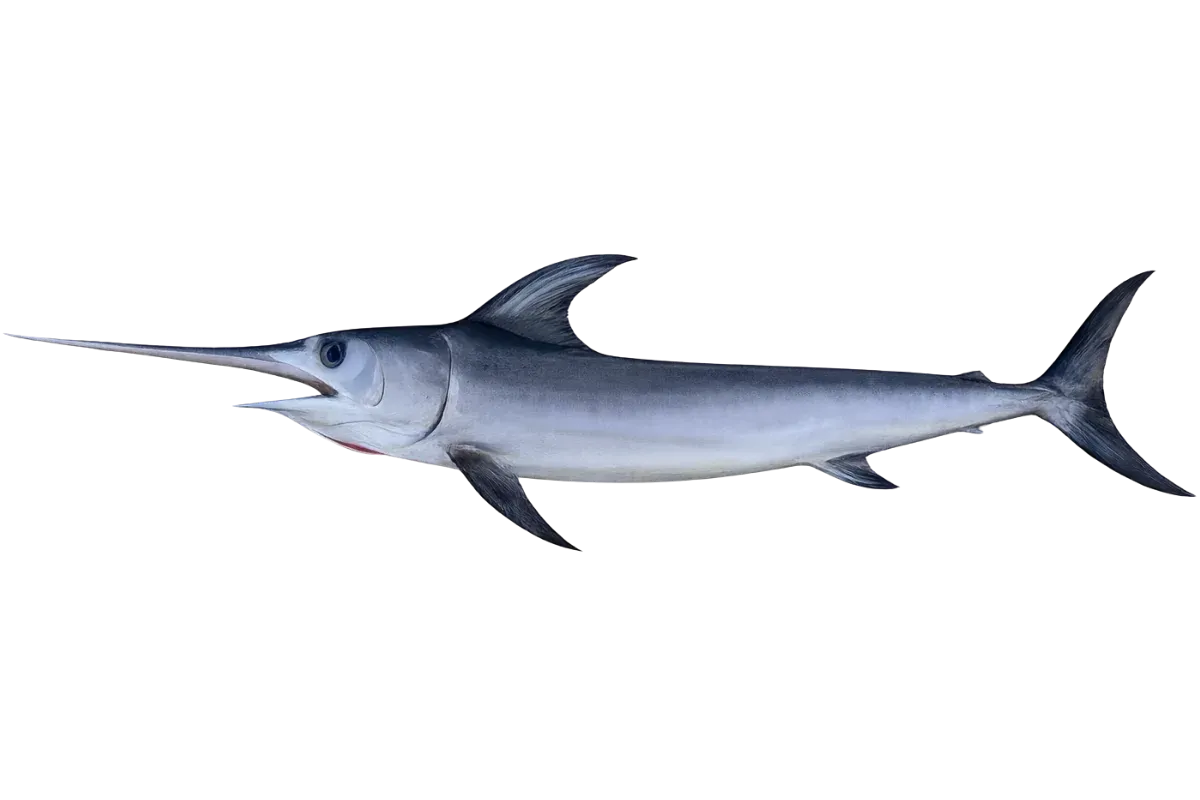
Swordfish
Xiphias gladius
The Swordfish, also known as the Broadbill or Broadbill Swordfish, is the absolute gladiator of the open sea and one of the most iconic fish in the world. It represents the sole member of the Xiphiidae family. The body is robust and round at the front, tapering toward the tail to take on a hydrodynamic shape. The skin of adults does not have scales, and the colour is dark brown or black on the back, which gradually lightens to silver and white on the belly.
The most famous characteristic is its bill or sword, which consists of an extension of the upper jaw. In contrast to the spearfish, which has a round spear, the sword of this fish is broad and flat, like a real sword with sharp edges. Additionally, it has a tall, sickle-shaped dorsal fin resembling a shark's, and it lacks pelvic fins entirely.
Habitat
It is a cosmopolitan and highly migratory pelagic species that lives in the open sea. It has a high tolerance to temperature changes and moves across a wide depth range from the surface down to 800 metres or deeper. It performs characteristic vertical migrations, meaning that during the day it descends to great depths to hunt in cold waters, and at night it rises to the warmer surface layers to feed.
Diet
The Swordfish is an apex and opportunistic predator. Its diet mainly consists of cephalopods such as squid and flying squid, which it hunts in the depths, along with pelagic fish such as mackerel, herring, and tuna. It uses its sword in a very specific way by charging rapidly into schools of prey and striking violently left and right to wound or stun its victims before swallowing them whole.
Reproduction
Reproduction of the Swordfish in the Mediterranean takes place during the summer months, mainly from June to August. Females lay millions of tiny pelagic eggs. The newborn fish are very different from their parents because they possess scales and spines, and their mouths have teeth, while both jaws are of equal length before the upper jaw starts to grow to form the sword.
Fisheries
It represents one of the most valuable commercial species worldwide. In regional waters, it is caught mainly by professional vessels using surface longlines and, formerly, harpoons. The meat is of exceptional quality, with a firm texture resembling that of animal steak, and it is usually sold in slices, commanding a very high price.
Research
The International Union for Conservation of Nature classifies the Mediterranean Swordfish as Near Threatened due to historical overfishing, although protection measures show signs of recovery. An important scientific discovery is that the Swordfish possesses a unique brain-heating mechanism. This involves specialised tissues behind the eyes that produce heat and maintain the brain and eyes at a temperature significantly higher than the surrounding water. This allows the fish to see and react rapidly, even in the freezing dark depths where it hunts.