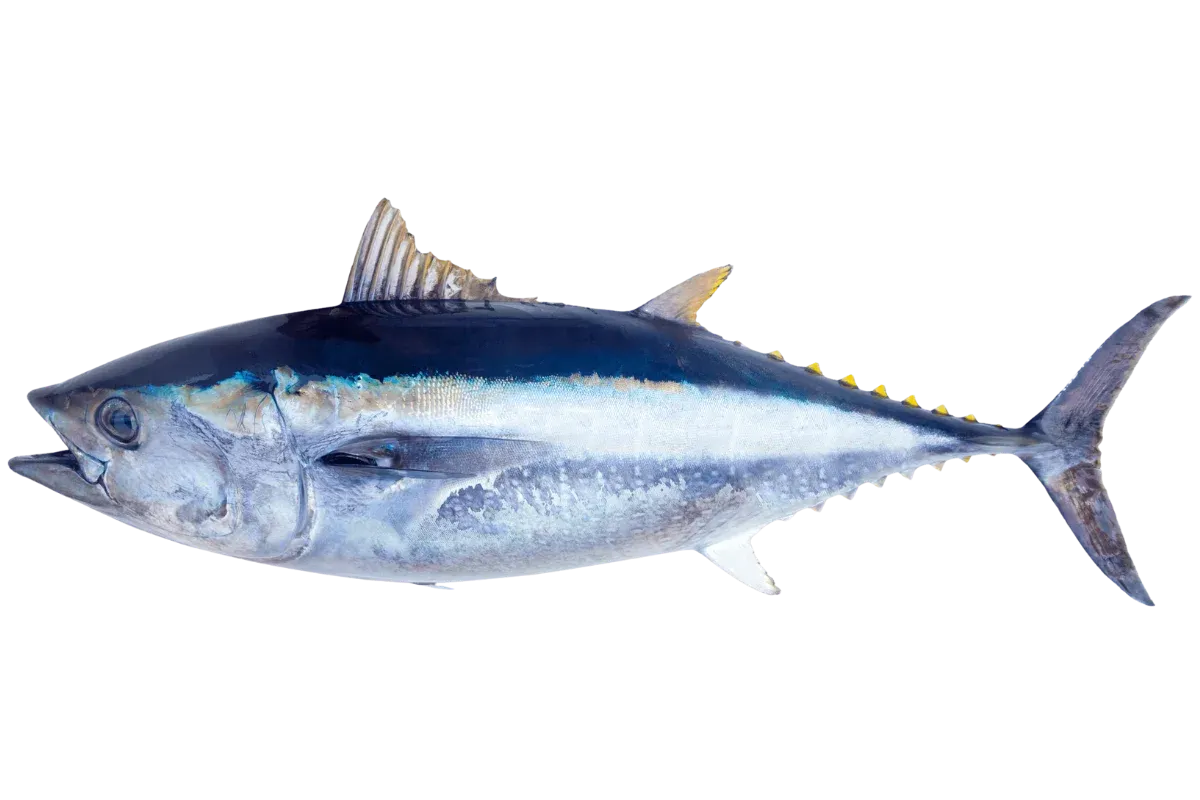
Atlantic Bluefin Tuna
Thunnus thynnus
The Atlantic Bluefin Tuna is the undisputed master of the open sea and one of the largest and fastest fish on the planet. It belongs to the Scombridae family, and it is famous for its dark red meat, which results from a high concentration of myoglobin. This protein transports oxygen to its powerful muscles. The body is bulky and robust, featuring a hydrodynamic torpedo shape designed to cut through the water with minimal resistance. Its colour is a deep metallic blue on the back, while the underside is silver white.
It is often confused with the Albacore, but there are fundamental differences. The Atlantic Bluefin Tuna is much larger, and its pectoral fins are short and do not reach the second dorsal fin, which contrasts with the exceptionally long fins of the Albacore. Furthermore, its meat is dark red like beef, while the flesh of the Albacore is light pink or white.
Habitat
This is a cosmopolitan and highly migratory pelagic species that lives in the open sea. It is a famous traveller who covers thousands of kilometres every year. Although it lives in the Atlantic Ocean, it migrates en masse to the Mediterranean every year to reproduce because these warm, calm waters are among its most important global spawning grounds. It moves across a wide depth range from the surface down to 1000 metres while searching for food and suitable temperatures.
Diet
As an apex and voracious predator, it sits at the top of the food chain. Juvenile fish travel in schools, while the giants move in small groups, and they consume massive amounts of food to maintain their rapid metabolism. They feed primarily on schooling surface fish such as sardines, round sardinella, mackerel, and horse mackerel, as well as squid and crustaceans.
Reproduction
The reproduction of the Atlantic Bluefin Tuna is an impressive phenomenon. Adult fish return to the same places where they were born, which is a behaviour known as philopatry. Breeding takes place during the summer months, mainly in June and July, in specific areas such as around the Balearic Islands, Sicily, Libya, and Cyprus. The eggs are pelagic, and small tuna grow at an explosive rate, reaching a weight of 1 kilogram within just a few months.
Fisheries
This is the most important and expensive commercial fish in the world. It is caught professionally with specialised purse seine nets and longlines. Often, the fish are captured alive and transported to fattening cages where they are fed intensively to increase their fat content. There is an enormous demand for the meat, especially in Japan, for the preparation of sushi and sashimi, with prices reaching astronomical levels at auctions.
Research
The International Union for Conservation of Nature previously classified the Atlantic Bluefin Tuna as Endangered, but thanks to strict management measures and quotas imposed by ICCAT, the populations are showing signs of recovery. It is currently classified as a Least Concern species. Its most important biological feature is that it is an endothermic or warm-blooded species. It possesses a specialised heat-exchange system known as the rete mirabile, which allows it to maintain its body temperature above that of the surrounding water. This provides the fish with immense muscular power, speed, and endurance, as well as the ability to hunt effectively in icy depths.