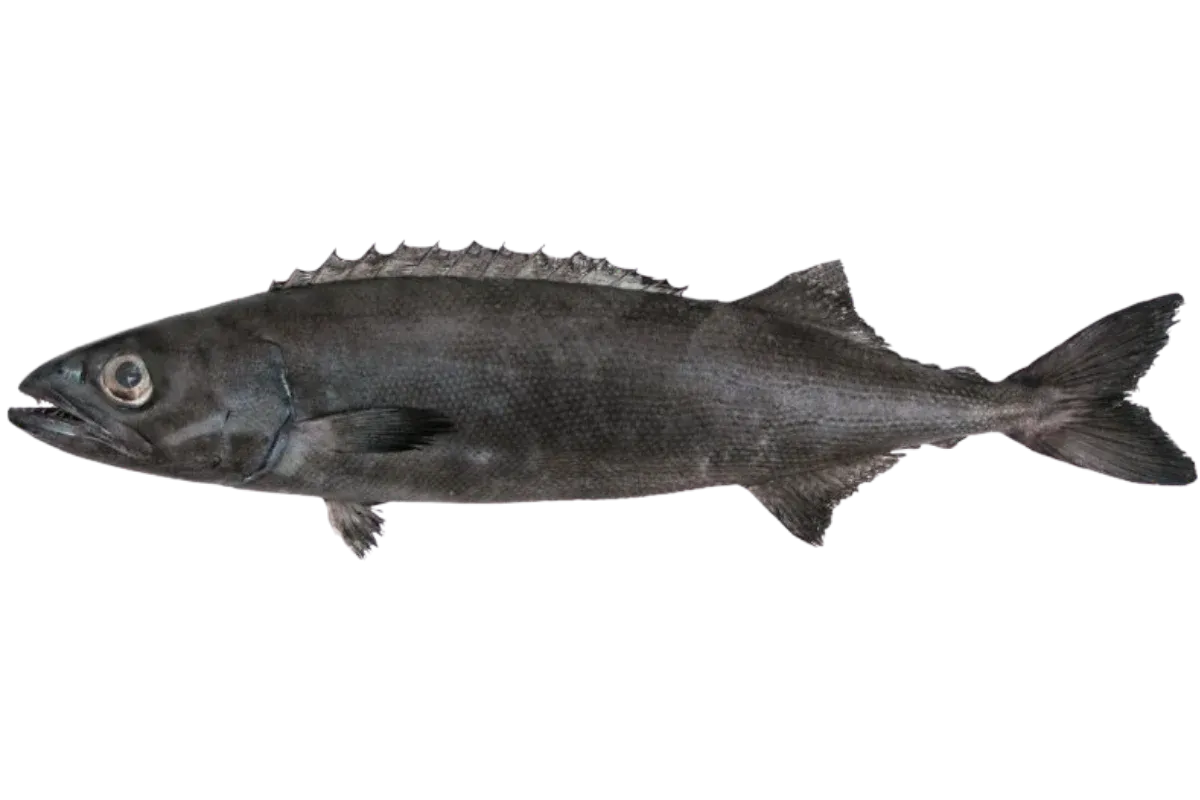
Oilfish
Ruvettus pretiosus
The Oilfish is a large and impressive deep-sea species belonging to the family Gempylidae, which also includes snake mackerels. The body is elongated and robust, spindle-shaped, and coloured from dark brown to black or violet.
Apart from its oily flesh, the most characteristic feature is the skin. It is extremely rough to the touch because it is covered with small, hard, and sharp bony tubercles that resemble sandpaper. It also possesses large eyes that glow slightly due to a tapetum lucidum, which is an adaptation for seeing in the darkness of the mesopelagic zone.
⚠️ Safety warning
Consumption of the Oilfish can cause severe gastrointestinal distress because the meat contains high concentrations of wax esters known as gempylotoxins. The human body is unable to digest these substances, and consumption of amounts exceeding 170 grams often leads to keriorrhea, which involves the involuntary discharge of orange oil accompanied by cramps and nausea. Although the fish is not poisonous, it has a powerful laxative effect.
Habitat
This is a benthopelagic species that lives and moves along the edges of the continental shelf. It is found at great depths, usually between 100 and 800 metres, although most individuals are located between 200 and 400 metres. It is a solitary fish that lives in pairs and rarely forms schools.
Diet
The animal is a fast and aggressive predator of deep waters. It feeds primarily on fish and cephalopods, such as squid, as well as crustaceans. It often performs vertical migrations by rising to shallower waters at night to hunt its prey.
Reproduction
Reproduction in the Mediterranean appears to occur during the summer months, with a likely peak in the middle and late season. It is an oviparous species, and females are usually more numerous than males in populations studied.
Fisheries
It is not a primary target of commercial fisheries due to the health issues caused by its consumption. It is usually caught as bycatch in deep longlines targeting swordfish and tuna, as well as in bottom trawls. In some countries, it is sold as fillets, often under misleading names like white tuna or butterfish, although its sale in certain markets, such as Japan and Italy, is prohibited or accompanied by strict warnings.
Research
The International Union for Conservation of Nature classifies the Oilfish as a species of Least Concern due to its global distribution. Scientific research has focused on its physiology and specifically its ability to accumulate wax esters in its tissues. This oil acts as a buoyancy aid, allowing the fish to move with minimal energy in deep waters while essentially replacing the role of a swim bladder.